
What's the (shr)impact?
Eyestalk Ablation and Shrimp Welfare

Every year, over 440 billion shrimp are farmed around the world. That’s more than five times the total number of all farmed land animals combined. Yet, despite these staggering numbers and recognition of their sentience, shrimp are among the most overlooked animals in our food system. Welfare concerns are rampant—and largely ignored.
Even before reaching slaughter age, around 50% of farmed shrimp die, amounting to approximately 1.2 billion shrimp deaths every single day.
And for those who do survive, conditions are grim.

“We recommend that all cephalopod molluscs and decapod crustaceans be regarded as sentient” - DEFRA (2021)
Studies show that shrimp face hundreds of hours of pain throughout the production process. Common practices include eyestalk ablation—a production method that is both inhumane, and largely hidden from public view.
For years, the global shrimp farming industry has relied on a breeding technique known as eyestalk ablation—thought to make hatcheries more efficient.
“Ablation gives producers predictability around spawning, which enables better planning for production” —Dr Belinda Yaxley.
The eyestalk of crustaceans, such as shrimps and crabs, contains glands important for moulting and reproduction. The X-organ-sinus-gland complex in the eyestalk of crustaceans produces and stores hormones, including the gonad-inhibiting hormone (GIH). This hormone controls the reproductive organs and when they mature and spawn. And removing this gland, by eyestalk ablation, is believed to speed up the maturation and breeding of farmed shrimp, by making them spawn sooner.
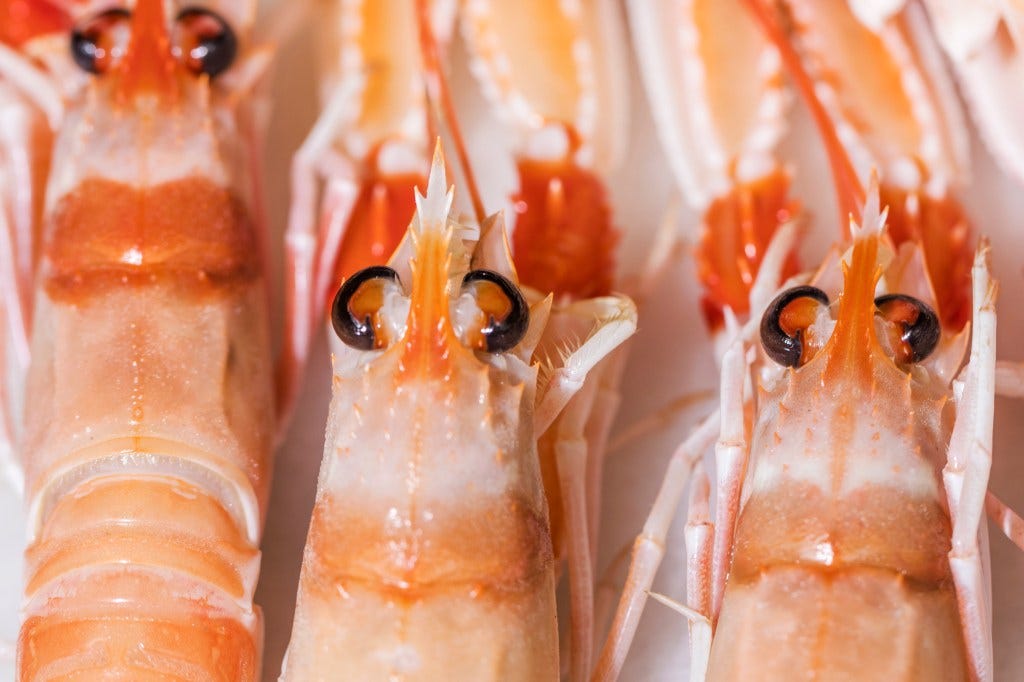
What’s the problem with eyestalk ablation?
Eyestalk ablation (ESA) occurs by cutting, crushing, or burning one or both eyestalks. It is carried out without pain relief and causes extreme distress to the animal, as indicated by their aversive behavioural responses. Scientists observed that shrimps that were subjected to ESA tried to escape. They were also observed to flick their tails and rub their eye area. When their wounds were covered or they were given medical treatment, they calmed down. Trigger Warning: Photo of the ESA process below.
“Shrimp demonstrate aversive behavioural responses to eyestalk ablation” —Shrimp Welfare Project
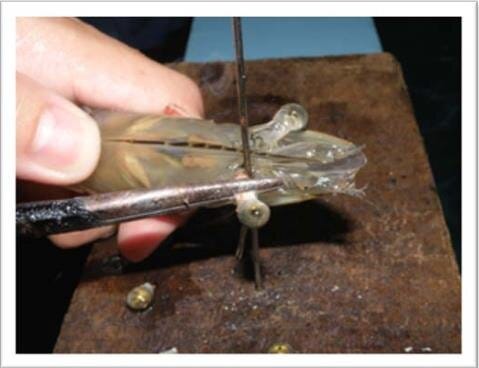
Another hormone affected by ESA is the moult-inhibiting hormone (MIH). When eyestalks are removed, moulting increases. This uses a massive amount of energy, causing the animals to become exhausted and stressed, and making it harder for them to reproduce in intensive farming settings.
Additionally, shrimp that have moulted have softer bodies, leading to them being eaten by other shrimps, as they cannot defend themselves without their hard shell.
Not only is eyestalk ablation painful and inhumane, but it may also increase costs by harming shrimp health as well as decreasing profits for farmers. The offspring from ablated females' are less tolerant of stress and are more likely to get diseases. There are many possible stress factors that compromise welfare for animals in aquaculture; such as handing, high stocking densities, crowding and poor water quality, to name just a few. Eyestalk ablation is one more thing that worsens their welfare.
And the absolute kicker is that ablation doesn’t actually improve shrimp production.
A 2019 study by Stirling University, debunked the notion that eyestalk ablation results in higher egg production and showed that alternatives to the practice could be cost neutral or even cost saving for farms
Studies show that animals who have not been ablated can have the same productivity levels as those who have. And yes, even when they are insensitively farmed, offspring show similar production potential and may even be more resilient to stress compared to offspring from ablated females. Studies have found that non-ablated females produce more eggs (> 20%) and nauplii larvae (> 16%) per day; and that there is no significant difference between hatching rates of ablated and non-ablated shrimps.
Clearly eyestalk ablation is not the only factor that affects shrimp productivity.
In fact, evidence suggests that there could be several factors including conditions during spawning, variation in fertility rates and general animal health.
And while animals who had their eyestalks removed did succeed in mating and spawning more often… this comes at a high cost. And just who pays it?
Eyestalk ablated shrimp have almost double the mortality rate and lower productivity in the long-term.
Whereas juveniles from non-ablated females have higher survival rates when affected by common shrimp diseases in aquaculture (such as Early Mortality Syndrome and White Spot Syndrome Virus).

Swimming towards better practices
The evidence is crystal clear. Ablation has no significant long-term advantages. Farmers should replace it practice with the use of non-ablated breeding animals. Changes in husbandry should be made to compensate for the lower mating rate of non-ablated animals. The use of non-ablated breeding animals means lower mortality rates for breeding animals, better animal welfare, higher productivity in the long-term, and less losses for producers. Improving shrimp wellbeing is not only ethically important, but better welfare supports economic success.
A Global Seafood Alliance (GSA) survey of global shrimp farmers and industry readiness for adopting alternative practices, in 2024, found that producers are responding to animal welfare concerns and growing pressure to end ablation but admit that getting there is a complex process that will take several years.
And simply telling farmers to stop doing ESA is not going to solve the issue.
However, organisations such as the Shrimp Welfare Project and the GSA are providing alternative solutions to achieve similar or better production without ESA:
Providing breeding animals with good quality nutrition during the pre-growth stage, as specialised diets designed for reproductive needs can significantly enhance natural spawning rates.
Maintaining a sex ratio of 1:2 male to female instead of the usual 1:1.
Using breeding animals for only a limited number of generations.
Considering closed-cycle breeding as an alternative to ESA. Meaning that producers breed successive generations of high-quality animals.
Creating optimal environmental conditions in hatcheries. Light cycles and water quality can stimulate natural ovarian maturation and spawning. Once these systems are in place operations become less labour intensive

Challenges in changing tides
The transition may not be as easy as it sounds.
The GSA survey found the challenges to ending ablation include costs, global educational barriers, market acceptance, regulation and policy considerations as well as the risk of reduced productivity due to less predictability around spawning.
The survey found that shrimp farmers were open to changing but when they tried to turn away from the ablation technique after requests from supermarkets, they met obstacles that helped to explain why it has endured for so long. And many farmers gave up. However, with more research, better infrastructure, and farmer training, there is proof that alternatives methods to ablation do work.
“While it may be challenging for some producers, eyestalk ablation should not be considered best practice in shrimp aquaculture” —Mike Kocsis, CEO of Global Seafood Alliance
If you are a shrimp farmer, supply chain professional looking to put shrimp welfare at the heart of your business and improve performance, or just a fellow shrimp enthusiast, you can find resources at Shrimp Hub. The FAI have just launched a free course shrimp welfare indicators which is available in eight languages!
Real life choices
“As consumers, we have the power to create meaningful change in food systems by purchasing wisely and choosing what we want to support with our hard earned money”
Although we may not feel like our choices matter. Or that one person can make a difference, but that just shrimply isn’t true.
As consumers, we have the power to create meaningful change in food production systems by purchasing wisely, and choosing what we want to support with our hard earned money. And that is why I wanted to write about eyestalk ablation. Because many people have no idea about it. And I believe in empowering people to make better ethical choices, (when they can) to help drive change in food systems.
“If you eat meat, the question is not how to win the argument online, it is whether the animal had a life you can stand behind, and whether the system you are buying into is one you would be comfortable showing to a child” - Helen Freeman
Consumer power does work.
In fact, due to public pressure about welfare concerns, several UK supermarkets such as Asda, Tesco, Ocado, M&S, Iceland, Morrisons, have committed to phasing out eyestalk ablation broodstock shrimp by 2027.
Co-op were way ahead of the curve, having already phased out ESA in their production lines since 2024.
However Lidl and Aldi have not made any firm commitments or timelines for change.
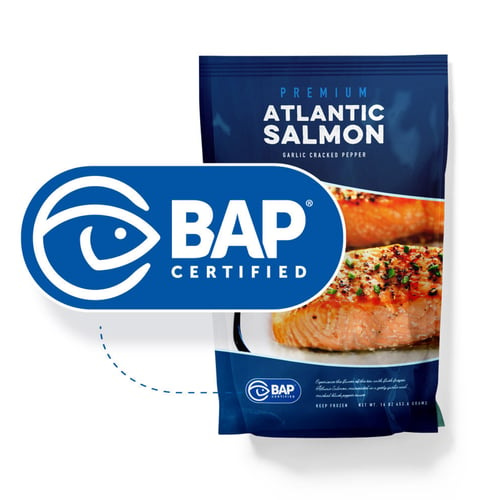
As of 2025, there were 1,900 shrimp farms and 150 shrimp hatcheries which were actively Best Aquaculture Practices-certified (BAP) and producing almost 800,000 tons of shrimp annually. However, although the BAP certified label may look like a winning purchase, eyestalk ablation is still very much occurring in these systems. And so it is important to be aware of what these welfare labels actually mean. Lest we succumb to “welfare washing.”
Although, it is heartening to hear that the Global Seafood Alliance (GSA) has announced that they will ban eyestalk ablation in their BAP-certified shrimp by 2030, and will support farmers to make the transition, which shows a significant shift in industry standards.
Transitioning the industry to better welfare farming techniques will require continued collaboration between scientists, farmers, retailers, and consumers to ensure that the shrimp on our plates comes from a system that respects the welfare of these fascinating creatures.
I’m not here to condemn anyone who eats shrimp or prawns, and I know that it isn’t realistic to expect everyone to suddenly stop eating animal products. But I am here to share all the information with you, so that you can make your purchase count for something that can improve billions of lives.
Yours in compassion,
Demi
I quit eating them years ago. So much torture of the natural world. Humans should be ashamed.
I had no idea. I will never eat shrimp again, knowing this. I swore off octopus long ago. And I know about the problems with farmed salmon. But few people care about crustaceans.